
Chapter 011945–1946
The Nuremberg Files
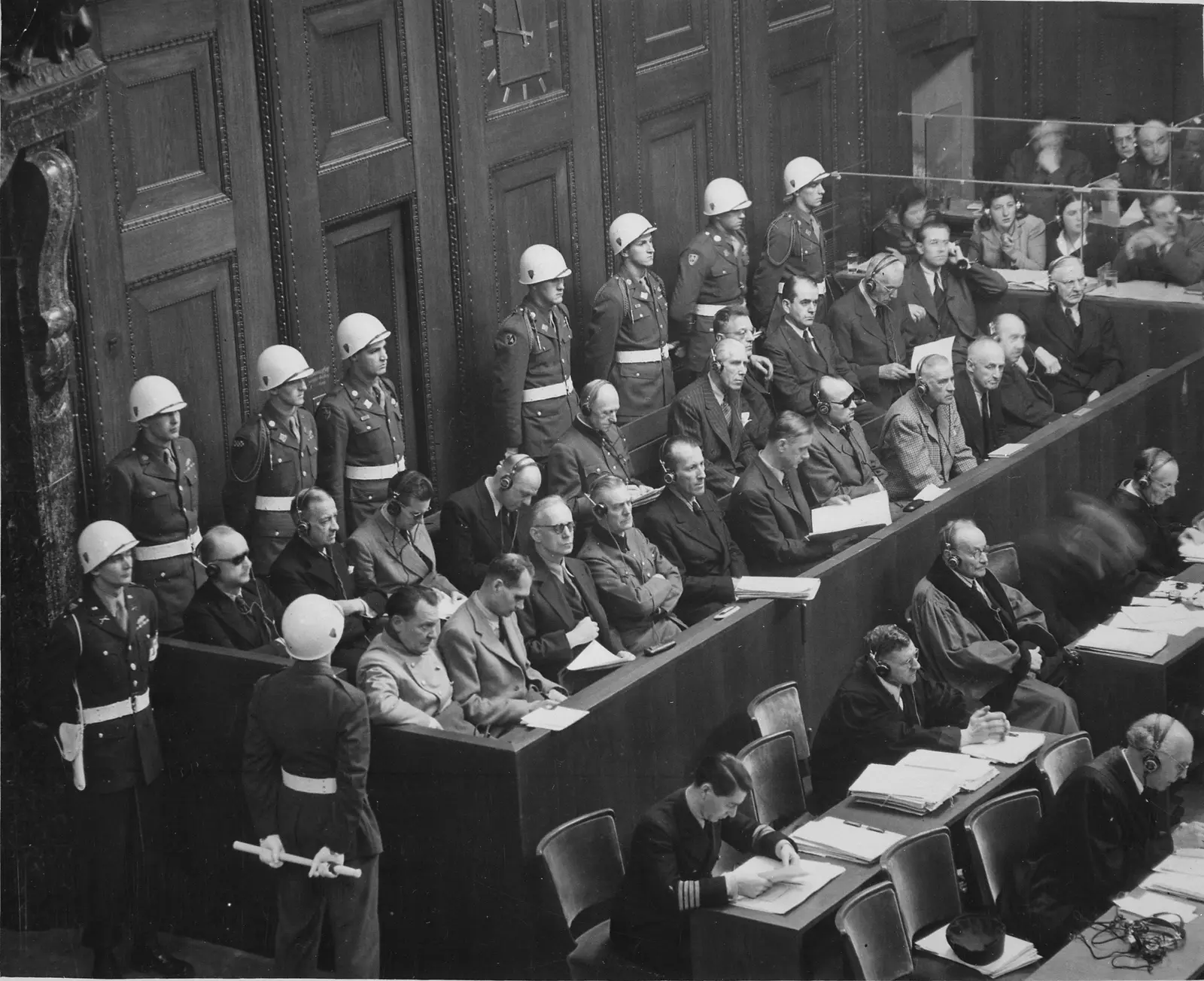
Nuremberg, 20 November 1945: judges from four nations open the trial of the Nazi leadership. We tell it in order, with original sound from the courtroom and every statement with its source: volume, page, reference.
Foto: US Army Signal Corps, NARA 540127, gemeinfrei
In order
Episodes
-
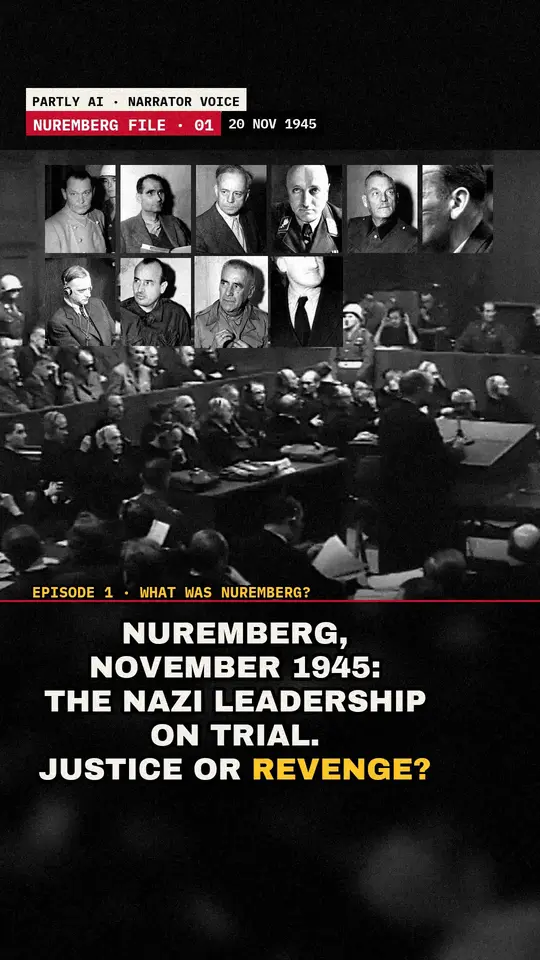
Nuremberg Files · Episode 01 · 1:52 min
Nuremberg 1945: justice or revenge?
Nuremberg, November 1945. The Nazi leadership stands before an international court. Justice or revenge?
- documented Nuremberg, November 1945: the Nazi leadership on trial.
- documented Judges from the United Kingdom, the United States, the French Republic and the Soviet Union.
8 documented · 0 open · 16 Sources · Source page
-
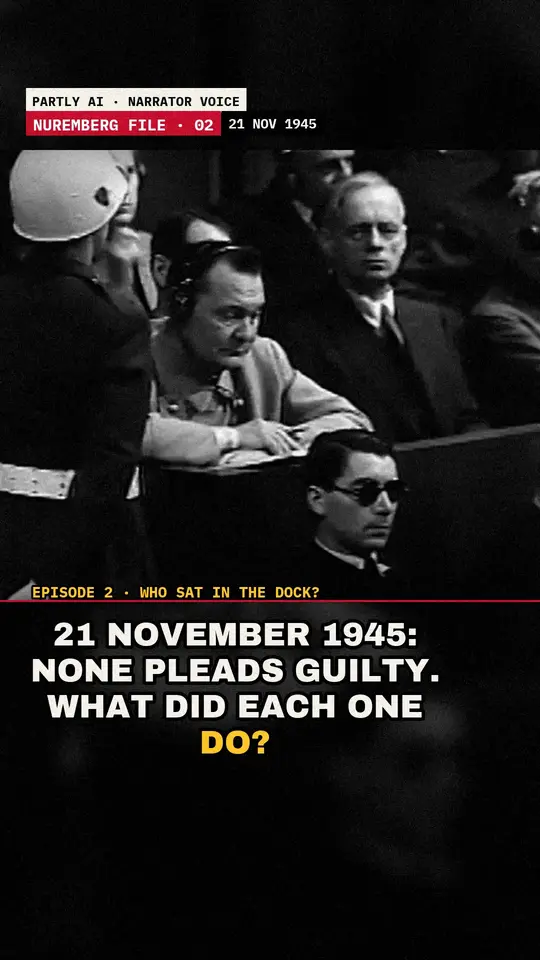
Nuremberg Files · Episode 02 · 2:35 min
Nuremberg trial: who sat in the dock?
21 November 1945, Nuremberg. None of the defendants present pleads guilty. What did each one do?
- documented Göring: Commander-in-Chief of the Luftwaffe.
- documented Judgment: Göring was the moving force for aggressive war, second only to Hitler.
14 documented · 1 open · 17 Sources · Source page
-
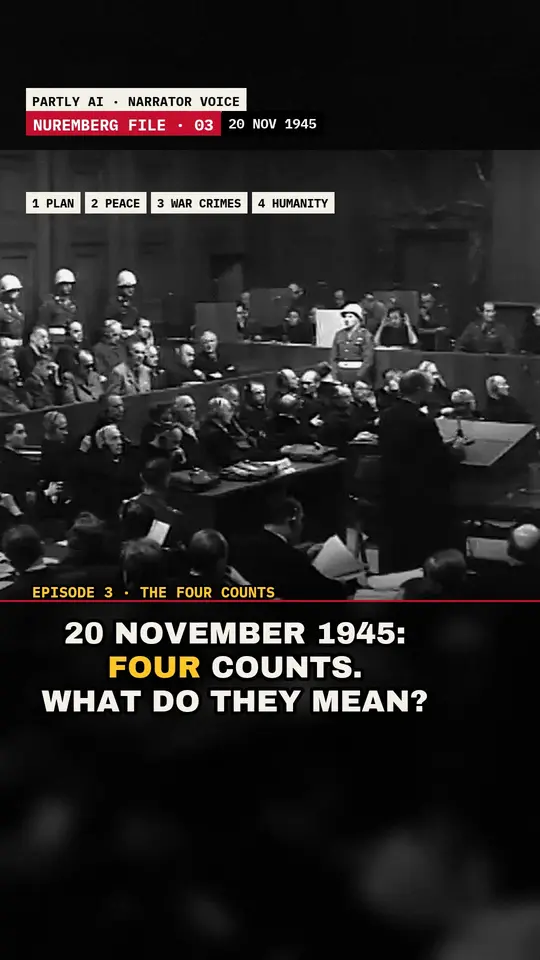
Nuremberg Files · Episode 03 · 2:08 min
Nuremberg trial: the four counts
20 November 1945: the Indictment is read. Four counts: common plan, crimes against peace, war crimes, crimes against humanity.
- documented Nuremberg, 20 November 1945: the Indictment is read.
- documented Count One: the common plan or conspiracy.
7 documented · 0 open · 11 Sources · Source page
-
Nuremberg Files · Episode 04 · 1:43 min
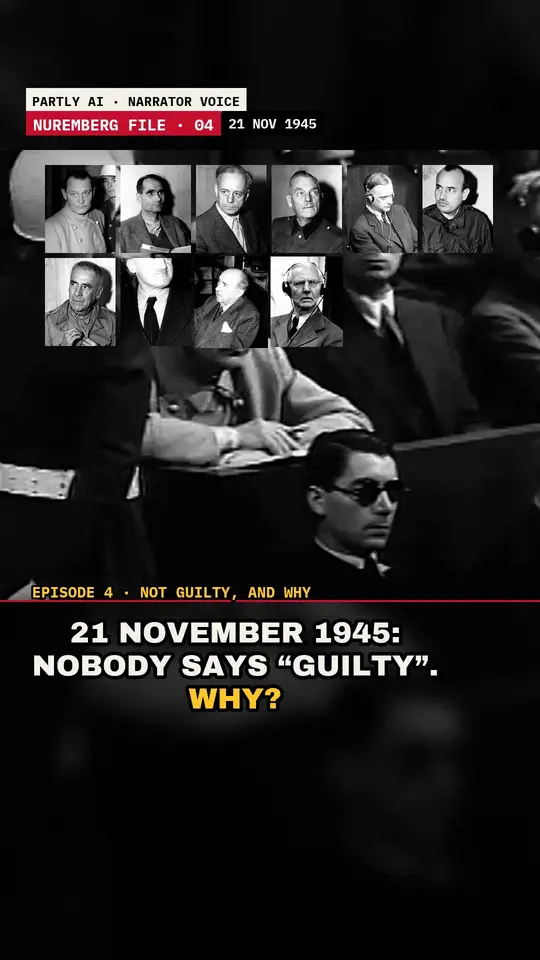
Nuremberg trial: not guilty, and why?
21 November 1945: none of the defendants present pleads guilty. Why?
- documented Asked to plead, Hess said no more than “No”; entered as not guilty.
- documented Schirach: not guilty “in the sense of the Indictment”.
6 documented · 2 open · 15 Sources · Source page
-
The defendants · Episode 05 · 2:17 min
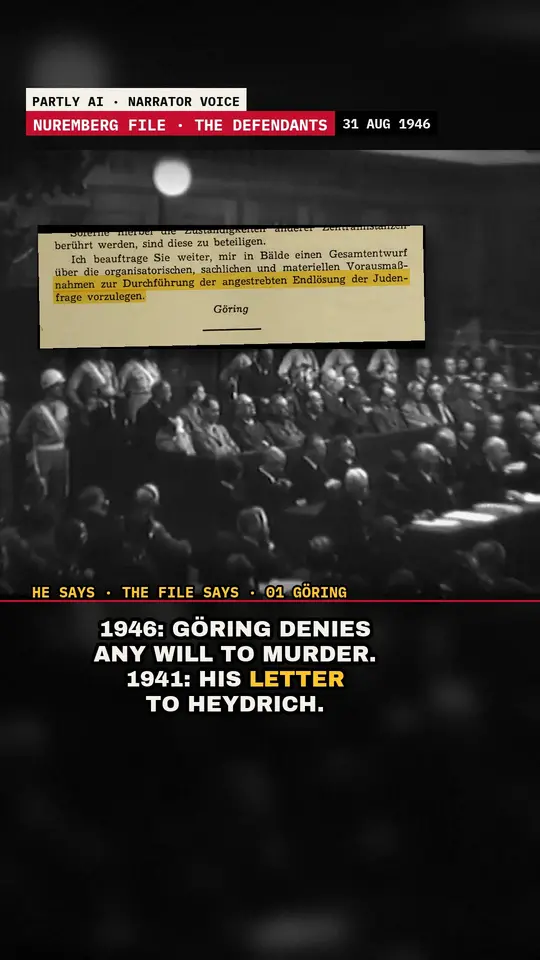
Göring: he says, the file says
31 August 1946, Nuremberg. Hermann Göring, defendant, gives his final statement. He stands up for what he did, he says, but emphatically denies acting from a desire to murder, rob or enslave.
- documented In 1946 Göring denies any will to murder. In 1941 he wrote to Heydrich.
- documented Göring: he stands up for what he did, but emphatically denies acting from a desire to murder, rob or enslave.
11 documented · 1 open · 12 Sources · Source page
-
The defendants · Episode 06 · 2:07 min
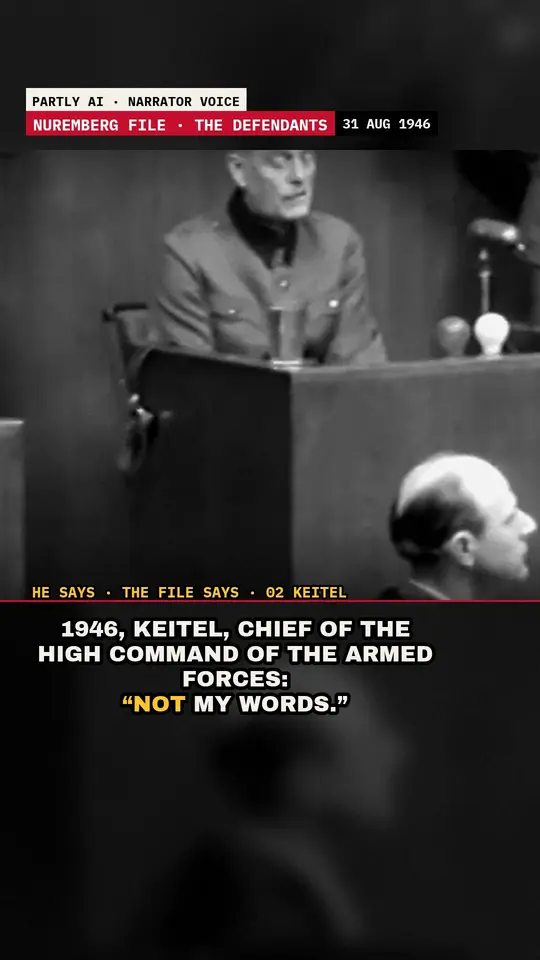
Keitel: he says, the file says
31 August 1946, Nuremberg. Wilhelm Keitel, Chief of the High Command of the Armed Forces, gives his final statement. The words about worthless human life are not his words, he says.
- documented Keitel: Chief of the High Command of the Armed Forces.
- documented Keitel, final statement: the words about worthless human life are not his words; he did not make them the contents of any order.
8 documented · 3 open · 15 Sources · Source page
-
The defendants · Episode 07 · 1:42 min
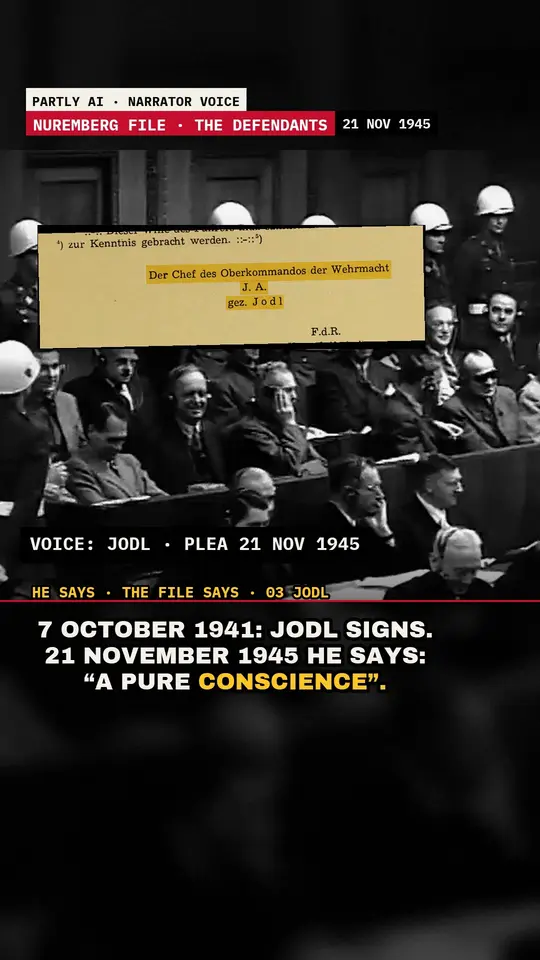
Jodl: he says, the file says
31 August 1946, Nuremberg. Alfred Jodl, Chief of the Operations Staff, says in his final statement that harsh measures, even if questionable under international law, are not a crime in morality or in conscience.
- documented 7 October 1941: Jodl signs. In 1946 he says: harsh measures are not a crime in morality or in conscience.
- documented Jodl: Chief of the Operations Staff of the High Command of the Armed Forces.
8 documented · 3 open · 17 Sources · Source page
Chapter 01
Short formats
Short pieces on single documents. Their statement lists follow; until then they are marked open.
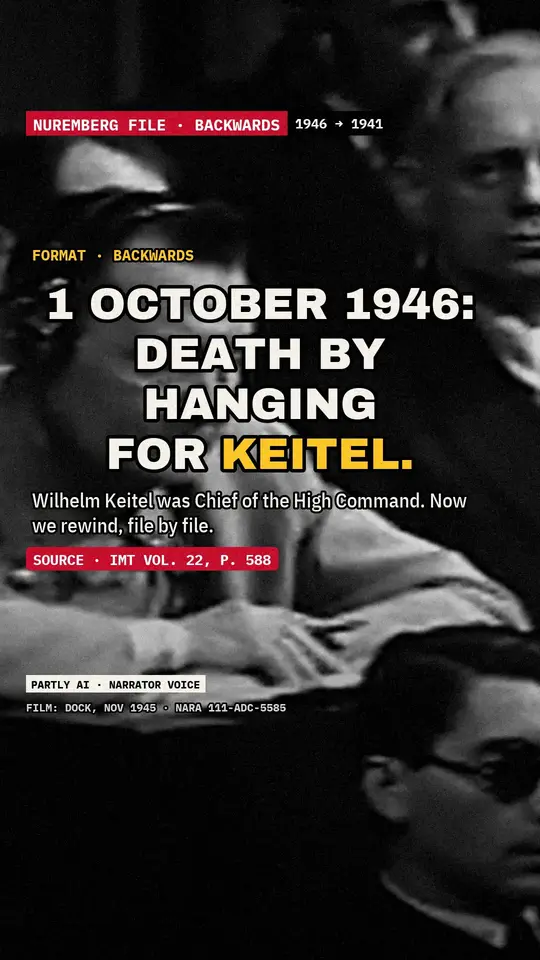
Rewind
1 October 1946: Keitel’s sentence, file by file in reverse
1 October 1946, Nuremberg: Wilhelm Keitel, Chief of the High Command of the Armed Forces, is sentenced to death by hanging. We rewind, file by file: the judgment, his note of September 1941, his order of 16 Sept 1941, hi …
open Statement list to followSources: audio NARA 238.3937B · IMT Vol. 22, pp. 535 to 536 and 588 · Vol. 36, p. 317 (338-EC) · Vol. 25, pp. 530 to 532 (389-PS) · Vol. 34, pp. 252 to 255 (050-C) · film NARA 111-ADC · stamp sound: Subhashish Panigrahi, CC BY 3.0 (Wikimedia Commons)
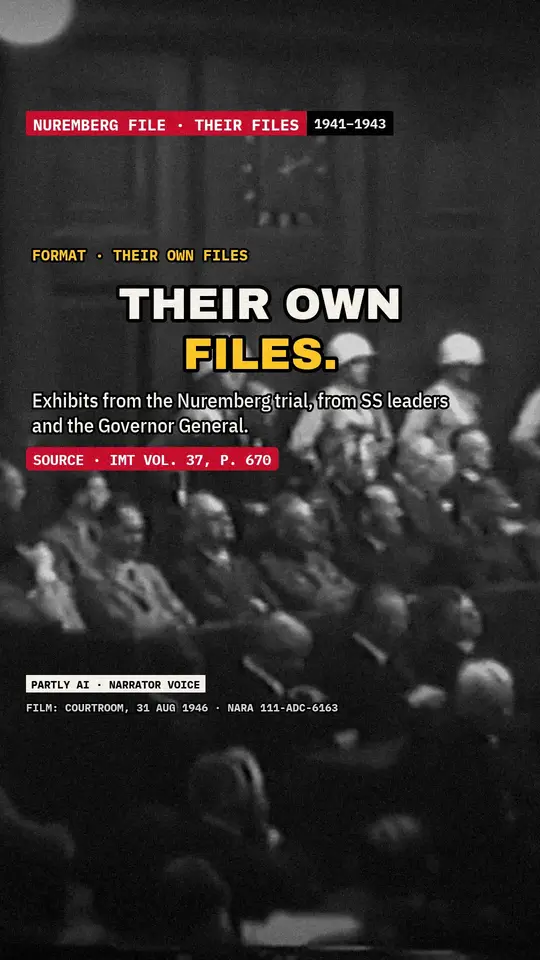
Their own files
No witnesses, no prosecutors
No witnesses, no prosecutors. Only documents written by SS leaders and the Governor General themselves, submitted as exhibits at Nuremberg: the Einsatzgruppe A report up to 15 October 1941, Hans Frank's government meetin …
open Statement list to followSources: IMT Vol. 37, pp. 670 and 702 to 703 (180-L, USA-276) · Vol. 29, pp. 498 and 503 (2233-PS) · Vol. 29, pp. 110 and 145 (1919-PS, USA-170) · film NARA 111-ADC · stamp sound: Subhashish Panigrahi, CC BY 3.0 (Wikimedia Commons)
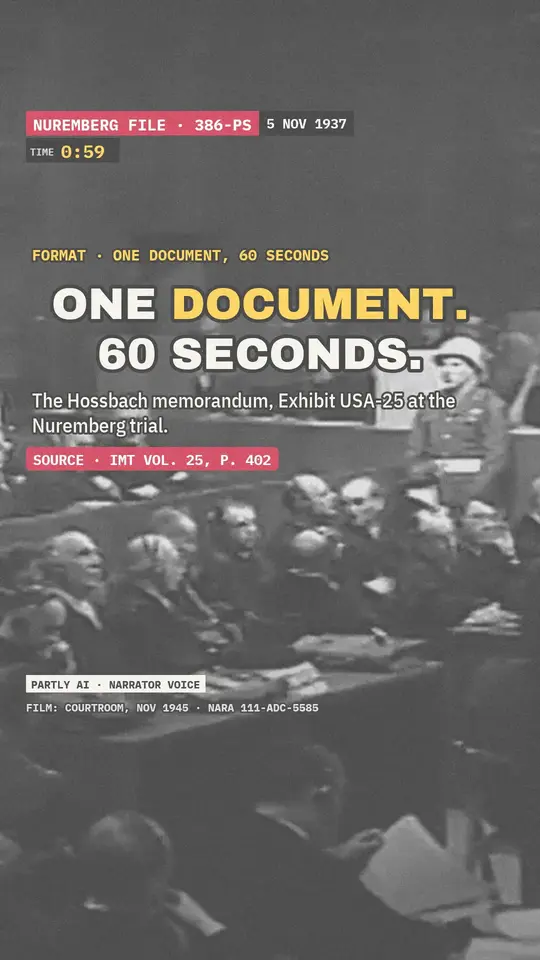
One document, 60 seconds
One document, 60 seconds: the Hossbach memorandum
One document, 60 seconds: the Hossbach memorandum. A meeting at the Reich Chancellery on 5 November 1937, written up by Hitler's adjutant Hossbach. Who was there, what it says, what the defense objected, what the court f …
open Statement list to followSources: IMT Vol. 25, pp. 402 to 413 (386-PS, USA-25) · Vol. 22, pp. 52, 65, 429 to 432 · Vol. 2, pp. 262 and 268 · audio NARA 238.87B · film NARA 111-ADC · stamp sound: Subhashish Panigrahi, CC BY 3.0 (Wikimedia Commons)
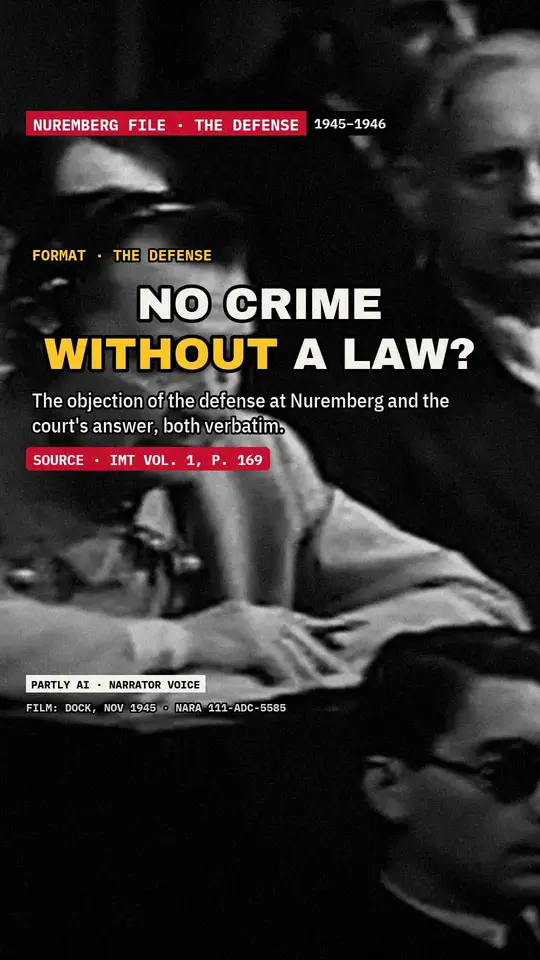
The defence
No crime without a law?
No crime without a law? That was the objection of all defense counsel at Nuremberg: only he can be punished who broke a law in force at the time of the act. Here is the defense in the original audio and the court's answe …
open Statement list to followSources: IMT Vol. 1, pp. 168 to 169 · Vol. 17, pp. 458 to 460 · Vol. 22, pp. 459 and 462 · audio NARA 238.3118B, 238.3907B · film NARA 111-ADC · stamp sound: Subhashish Panigrahi, CC BY 3.0 (Wikimedia Commons)
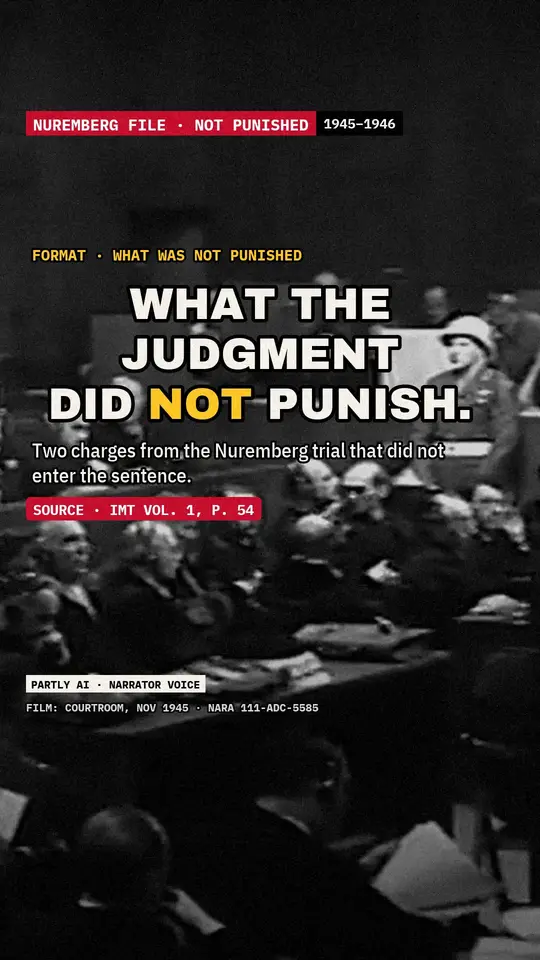
What was not convicted
Two charges from Nuremberg that did not enter the sentence
Two charges from Nuremberg that did not enter the sentence. Katyn: charged, presented by the Soviet prosecution as a German crime, not mentioned in the judgment. Submarine warfare: according to the judgment, Dönitz's sen …
open Statement list to followSources: IMT Vol. 1, p. 54 · Vol. 7, pp. 423 to 425 · Vol. 22, pp. 556 to 559 and 588 · full-text search of the judgment, Vol. 1, pp. 171 to 341, Vol. 22, pp. 411 to 589 · film NARA 111-ADC · stamp sound: Subhashish Panigrahi, CC BY 3.0 (Wikimedia Commons)
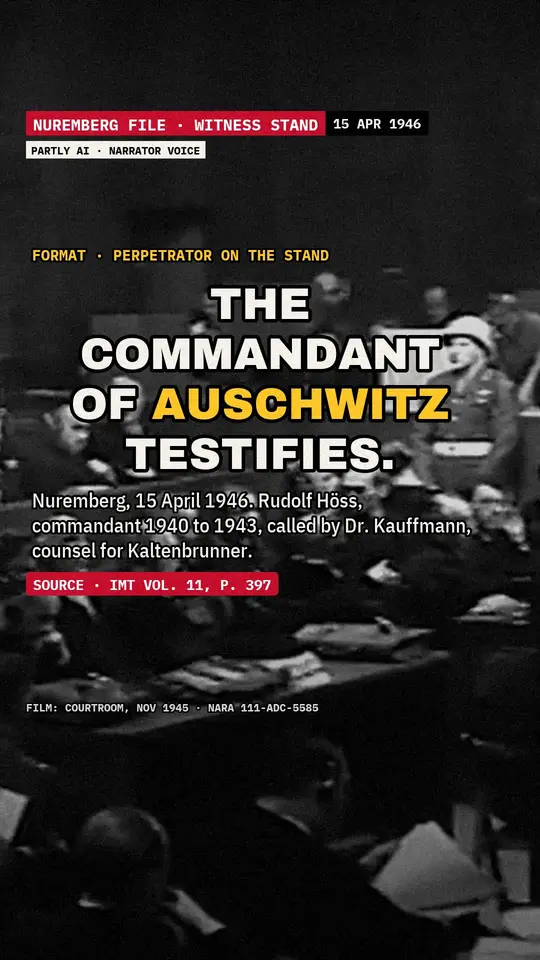
Perpetrators on the stand
15 April 1946: Rudolf Höss on the stand
15 April 1946, Nuremberg. Rudolf Höss, commandant of Auschwitz 1940 to 1943, testifies as a witness. He was called not by the prosecution but by Dr. Kurt Kauffmann, counsel for Kaltenbrunner. Question and answer in the o …
open Statement list to followSources: audio NARA 238.1951B, 238.1952B · record IMT Vol. 11, pp. 396 to 402 · film NARA 111-ADC · stamp sound: Subhashish Panigrahi, CC BY 3.0 (Wikimedia Commons)
In preparation
Planned episodes
The plan for the rest of the chapter. Order and titles can change; dates are set only when an episode is finished.
- 08Hans Frank: he says, the file saysIn preparation
- 09Sauckel: he says, the file saysIn preparation
- 10Ribbentrop: he says, the file saysIn preparation
- 11Kaltenbrunner: he says, the file saysIn preparation
- 12Schacht: acquittedIn preparation
- 13Papen: acquittedIn preparation
- 14Fritzsche: acquittedIn preparation
- 15Revenge or law? Jackson’s openingIn preparation
- 16“No crime without a law?”In preparation
- 17Evidence from their own filesIn preparation
- 18Orders are orders?In preparation
- 19Speer: responsibility, but for what?In preparation
- 20The film in the courtroomIn preparation
- 21Streicher: incitement on trialIn preparation
- 22AcquittedIn preparation
- 23The judgmentIn preparation
- 24Background: the Hague Convention of 1907In preparation
- 25Background: Napoleon, 1815In preparation
- 26Background: the General StaffIn preparation
- 27Subsequent trials: the doctorsIn preparation
- 28Subsequent trials: the juristsIn preparation
- 29Today: orders and conscienceIn preparation
- 30Today: The HagueIn preparation